
County Mulls Stiffer Dog Ordinance
Elizabeth Bunton - Staff Writer Herald Dispatch
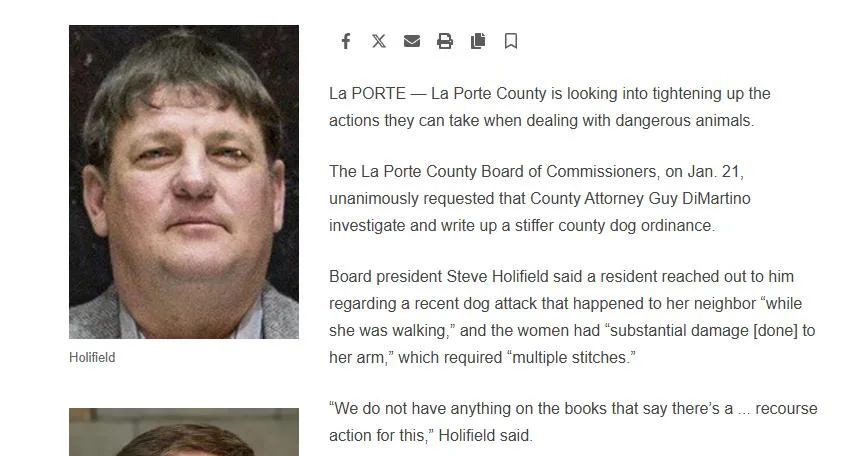
The source article is shown as a reference. Analysis and conclusions are my own.
La Porte County officials are considering a “stiffer dog ordinance” following a reported dog bite incident. The suggestion has been made that the county lacks adequate tools to deal with dangerous animals and should look to adopt an ordinance similar to what exists inside the City of La Porte.
That claim deserves a closer look.
We reviewed the newspaper coverage, Indiana state law, and the City of La Porte’s animal ordinance. What we found is straightforward: Indiana law already provides strong enforcement when a dog seriously injures someone. The proposal on the table is not about closing a legal gap — it’s about expanding regulation.
Indiana law is not silent on dangerous dogs. In fact, it already provides:
Strict liability for dog owners when an unprovoked bite occurs
Criminal penalties that escalate from misdemeanors to felonies if serious injury or death results
Authority to impound animals involved in qualifying attacks
Civil remedies that allow victims to recover damages
When real harm occurs, there is already legal recourse. The idea that there is “nothing on the books” simply does not hold up.
Indiana State Statute IC 15-20-1
The City of La Porte’s animal ordinance goes well beyond responding to serious attacks. It establishes a regulatory framework built on subjective standards and administrative enforcement, including:
Broad definitions of “dangerous” based on prior complaints, perceived behavior, or repeated nuisance reports
Enforcement for animals deemed noisy, annoying, or “at large”
Administrative hearings instead of traditional courts
Escalating fines, mandatory signage, inspections, and behavioral mandates
Authority to restrict or prohibit future pet ownership
This approach is not just about safety after an incident. It is about ongoing supervision of private behavior.
City of LaPorte Municipal Code Chapter 6
Counties are not cities. They include farms, large properties, rural neighborhoods, and residents who intentionally choose to live outside municipal boundaries.
Many people do so for a reason: less government micromanagement, fewer complaint-driven enforcement actions, and greater personal responsibility.
Turning county government into a city-style regulatory body fundamentally changes that relationship. It replaces enforcement of actual harm with proactive policing of behavior — the very thing many residents move away from cities to avoid.
No one is arguing that dangerous animals should be ignored. They already aren’t. State law provides tools to respond when serious injury occurs.
What’s being proposed is a shift from:
Addressing real harm
to
Regulating potential behavior and neighbor complaints
That is not a minor change. It is a philosophical one.
County commissioners are not just administrators — they are policymakers. That role requires more than reacting to a single incident or a news headline.
It requires:
Understanding what the law already does
Knowing where authority already exists
Weighing unintended consequences before expanding government power
Good policy starts with research.
Good governance starts with knowing the difference between enforcement and regulation.
Before proposing new ordinances, commissioners owe residents a basic level of due diligence: Is this actually necessary, or does the law already address the problem?
La Porte County can protect public safety without drifting toward a nanny-state model of governance. Freedom and responsibility are not opposites, and we don’t need to import city-style regulation to achieve accountability.
County government should remain focused on real harm, real solutions, and a clear understanding of the law — not regulation for regulation’s sake.
That balance is what residents expect. And it’s the standard county leadership should meet.